








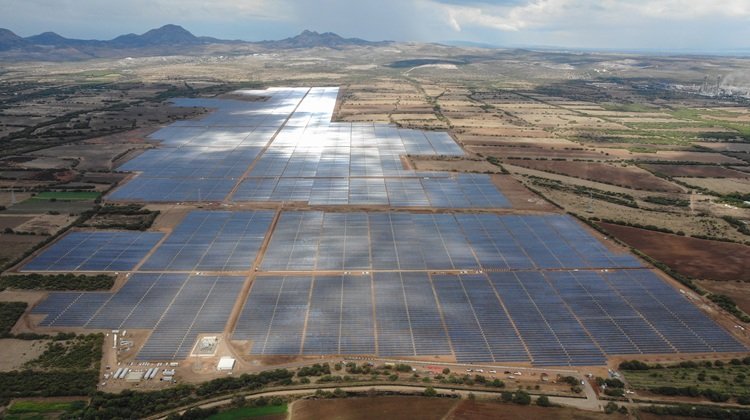
The board of directors of Spanish renewable energy developer Energía Aljaval has approved its 2026–2027 Strategic Plan, placing Mexico at the centre of the company’s global expansion strategy.
The plan includes eight utility-scale renewable energy projects combining solar photovoltaic (PV) generation and battery energy storage systems (BESS), with a total capacity of more than 2.1 GW. The portfolio is designed to capitalise on the rapid industrial expansion driven by nearshoring, as international companies relocate manufacturing operations closer to North American markets.
After more than a decade of continuous presence in Mexico since 2013, the company aims to position itself as a key player in the country’s next phase of the energy transition and renewable power investment.
As a first operational milestone under the new plan, Energía Aljaval has formally submitted four photovoltaic projects — Pinos, General Cepeda, Santa Lucía and Chapote — to the VUPE (Single Window for Strategic Energy Sector Projects), a regulatory platform designed to streamline permitting and grid-connection procedures for large energy developments.
These projects are located in strategic regions characterised by high solar irradiation and strong industrial electricity demand, supporting both grid integration and future power purchase agreements (PPAs) with large energy consumers.
Solar PV pipeline under development in Mexico
| Project | Location | Capacity |
|---|---|---|
| Pinos | Zacatecas | 356.5 MWp |
| General Cepeda | Coahuila | 183.1 MWp |
| Santa Lucía | Campeche | 223.03 MWp |
| Chapote | Coahuila | 83.6 MWp |
| San Francisco | Coahuila | 409.3 MWp |
| San Isidro | Coahuila | 395.4 MWp |
| Alsacia | Chihuahua | 377.4 MWp |
| Gómez Farías | Coahuila | 125.5 MWp |
Four of these projects already have official grid-connection applications registered in the VUPE system, marking a key step towards development approval.
All eight assets follow a unified development schedule, with the goal of reaching Ready-to-Build (RTB) status by the end of 2027 and achieving Commercial Operation Date (COD) by December 2029.
BESS integration to enhance project revenues
A defining feature of the portfolio is the integration of battery energy storage systems (BESS) across all projects.
Each facility will incorporate storage capacity equivalent to 30% of its installed power, representing more than 500 MW of battery storage in total.
This hybrid configuration is expected to unlock additional revenue streams through:
-
Capacity markets
-
Ancillary grid services
-
Energy arbitrage and peak-shaving
Such capabilities improve grid flexibility and reliability, while also enhancing the financial bankability of renewable assets in increasingly competitive electricity markets.
A decade of renewable development in Mexico
The new strategic roadmap builds on Energía Aljaval’s long-standing presence in the Mexican energy sector.
Since receiving its first authorisations from the Mexican Energy Regulatory Commission (CRE) in 2014, the company has brought hundreds of megawatts of solar capacity into commercial operation, including projects such as El Trece Solar and Torrencitos in the state of Chihuahua.
In total, the company has already delivered more than 660 MW of installed renewable capacity connected to Mexico’s national grid across previous development phases.
Globally, the group operates over 900 MW of renewable energy capacity in Latin America and continues to expand its development pipeline in Europe and Brazil, reinforcing its execution capabilities for the projects now advancing towards the RTB stage.
Company outlook
According to the company’s management, the strategy goes beyond simply developing renewable capacity.
“At Energía Aljaval we do not only develop megawatts; we structure comprehensive solutions for firm and clean energy supply. Our continuous presence in Mexico since 2013 has given us the resilience and local expertise to deliver a mature, bankable portfolio of more than 2.1 GW ready to support the country’s new industrial growth,” the company stated.
The recent submission of the Pinos, General Cepeda, Santa Lucía and Chapote projects through the VUPE platform, executives added, demonstrates that the company is prepared to move forward with execution.