







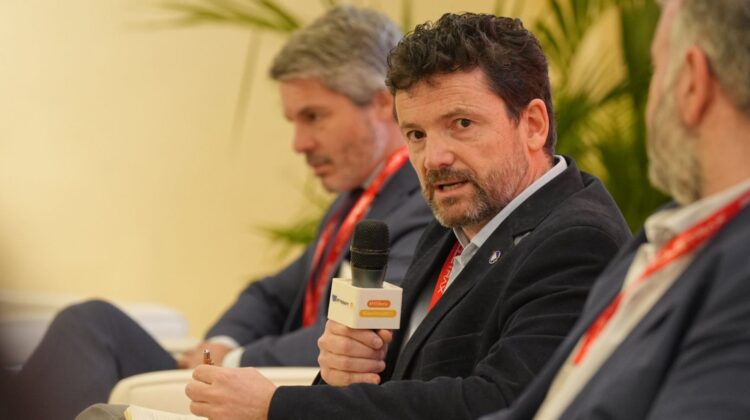
The expansion of the battery sector in Spain is moving forward, but it still faces structural obstacles that condition its large-scale development. Jesús Heras, Technical Director SouthWest Europe at Wattkraft, warned that the sector’s growth will largely depend on the evolution of the regulatory framework and the creation of market tools capable of consolidating investment.
“The problem is that these opportunities, if there is no regulation, will not favour structural growth in energy storage. They are opportunities to take a gamble, because you have to be opportunistic. But we need to improve the regulation,” Heras said during his participation in Future Energy Summit Iberia 2026, an event that brought together more than 400 executives from the energy sector.
In this context, the executive argues that the lack of clear rules means that projects move forward in a sporadic or speculative way, rather than responding to sustained planning within the power system.
“With the European Regional Development Fund (ERDF) funds there will of course be a strong push. But if we want more systemic, long-term growth rather than bubbles, we need regulation,” he noted.
He added: “I understand that right now there is some concern about making investments that are not backed by regulation. Once that regulation is more fully implemented, with capacity payments and other mechanisms, we will move towards more solid growth.”
While awaiting regulatory definitions for large-scale projects, the deployment of batteries in Spain has found one of its first areas of development in industrial self-consumption, particularly among large energy consumers seeking to optimise their electricity demand.
“They talk about cheap electricity, but that is in the wholesale market. Then industrial consumers face grid charges and other costs that currently make behind-the-meter storage difficult to justify economically,” he said.
However, he added: “It has other advantages beyond savings or revenues. You gain greater security of supply. If there is a power outage, you have backup.”
In this context, the company has developed several projects in this segment since 2023, when it introduced its first containerised battery system in the Spanish market with technology from Huawei, mainly focused on industrial applications with high energy demand.
So far, the company has participated in large-scale industrial projects within the Spanish market. “We have built 28 MWh self-consumption plants. In self-consumption the situation is better in terms of flexibility and dynamic demand regulation,” he highlighted.
“With the new self-consumption royal decree and the aggregation framework that was released this week, we will be able to extend this model to self-consumption plants in less heavy industry and in the broader commercial and industrial segment,” he said.
However, Heras warned that smaller-scale projects still face economic limitations, as the cost of battery systems does not always allow developers to benefit from economies of scale as they can in larger installations.
“Some kind of support from the administration or from IDAE through subsidies for these types of installations will still be necessary if we want more systemic growth,” he noted.
It is worth recalling that a recent aid mechanism under the ERDF programme awarded around 9.4 GWh of energy storage capacity in Spain, supporting a new pipeline of projects across different regions of the country.
From a technological standpoint, Heras emphasised that batteries are complex infrastructures that require high standards of quality and control, warning about the risks of prioritising cost reductions alone in industrial development.
“A battery is a highly technological component. You cannot simply convert any factory overnight that cannot guarantee quality or long-term durability,” he said.
At the same time, the executive addressed the debate around boosting European battery manufacturing, arguing that technological competitiveness will remain a decisive factor in the global market. “Today, let’s be honest, the most competitive and technologically advanced products come from China,” he said.
Looking ahead, Heras explained that an increasing number of industrial companies are adopting integrated energy models, combining renewable generation and batteries to optimise their energy consumption.
“We have clients that operate large industries and at the same time act as independent power producers. They have their own energy divisions. They create their own industrial power purchase agreements: they build their solar or wind plants, add batteries and flatten their consumption curve,” he explained.
According to the executive, these kinds of schemes could multiply in the coming years, both in self-consumption projects and in hybrid renewable plants developed by energy and industrial companies.
Finally, Heras stressed that the value of batteries within the energy system depends largely on the management and control systems that optimise their operation.
“If you only have the battery, it is just a very large paperweight. You need control software — an Energy Management System,” he concluded.