












Argentina’s renewable energy investment cycle will largely depend on the return of stronger electricity demand, according to Martín Brandi, CEO of the Argentine energy company PCR.
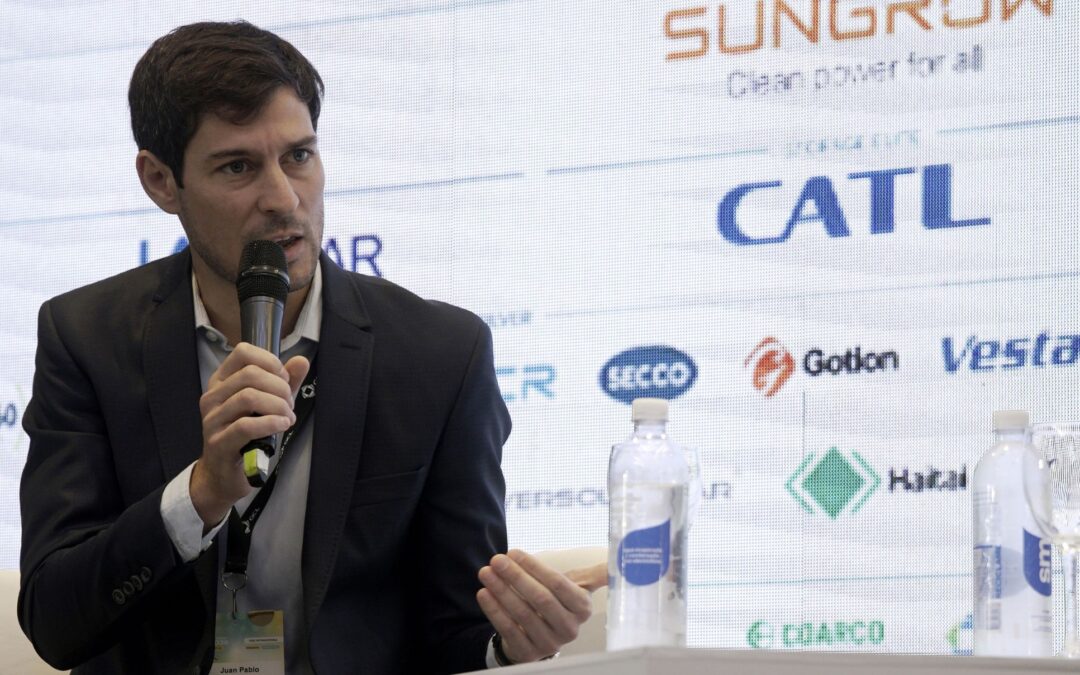
Speaking during the Future Energy Summit Argentina (FES Argentina), Brandi explained that the country’s power market is currently characterized by lower electricity prices and generation supply growing faster than consumption.
This imbalance is reshaping investment decisions in renewable energy, particularly wind power and solar PV, as developers reassess project economics.
“When demand appears, renewables will react quickly,” Brandi said. Argentina has a very dynamic generation industry. Projects will emerge quickly when demand materialises, and ideally, we should anticipate the infrastructure needed to supply it.”
He added that future industrial demand — particularly from mining projects — could become a key driver for new generation capacity.
“If we expect large mining demand, the infrastructure needed to supply it will be critical. The renewable energy sector and the generation industry in general are dynamic and will be able to provide solutions.”
Brandi also warned that the Argentine electricity market is going through a period in which launching new generation projects has become increasingly difficult.
The main challenge stems from the combination of declining power prices and electricity demand that has not expanded at the pace expected, despite the rapid growth in supply in recent years.
In this context, the economic equation for new projects has become more complex, particularly for developers seeking to recover capital investments within reasonable timeframes.
“From a generation perspective, it’s currently a difficult time to launch new projects if the goal is to recover capital,” Brandi said during the panel discussion on project profiles, business models, and long-term market expectations.
Despite the challenging market environment, PCR continues advancing key renewable projects within its portfolio.
Among them is the Olavarría wind farm, a 185.6 MW wind power project that became the second renewable project admitted to Argentina’s Large Investment Incentive Regime (RIGI).
The project is being developed in partnership with the global steel company ArcelorMittal.
Key project details
| Project | Olavarría Wind Farm |
|---|---|
| Capacity | 185.6 MW |
| Total investment | USD 275 million |
| Partner | ArcelorMittal |
| Financing | International Finance Corporation (IFC) |
| Regulatory framework | Argentina’s RIGI investment regime |
The development also includes 25 km of transmission infrastructure connecting the wind farm to the Olavarría transformer substation.
Additionally, upgrades to capacitor banks at the Olavarría and Ezeiza substations will increase the transmission capacity of Argentina’s national grid, known as the Sistema Argentino de Interconexión (SADI).
“Construction of the Olavarría wind farm is halfway complete. We are also expanding our Mataco–San Jorge wind park by 37 MW,” Brandi said.
The expansion will increase the project’s installed capacity from 203.4 MW to 240 MW in the province of Buenos Aires.
With these developments, PCR — an Argentine company with more than 100 years of operations in oil and gas, cement and renewable power generation — will further expand its renewable portfolio, which currently totals 545 MW installed across Santa Cruz, Buenos Aires and San Luis provinces.
Storage auctions could strengthen grid flexibility
Brandi also highlighted the potential role of battery energy storage systems (BESS) in improving grid operation in Argentina.
In particular, he referred to the AlmaGBA auction, which awarded 713 MW of storage capacity in 2025, and the recently launched AlmaSADI program, aimed at allocating 700 MW of battery storage across the country.
“It’s a good initiative. Incorporating batteries where the system needs them makes sense,” he said.
However, Brandi emphasised that storage deployment should be aligned with actual system needs, rather than driven purely by pricing opportunities.
“The question is how much storage should be awarded and when. Everything the system needs should be awarded as soon as possible. But it also doesn’t make sense to allocate more capacity just because prices are attractive,” he concluded.