Currently, the deployment of grid-connected battery storage in Argentina remains limited. However, the executive believes that new regulatory initiatives and upcoming tenders under discussion could accelerate the sector’s development in the coming years.
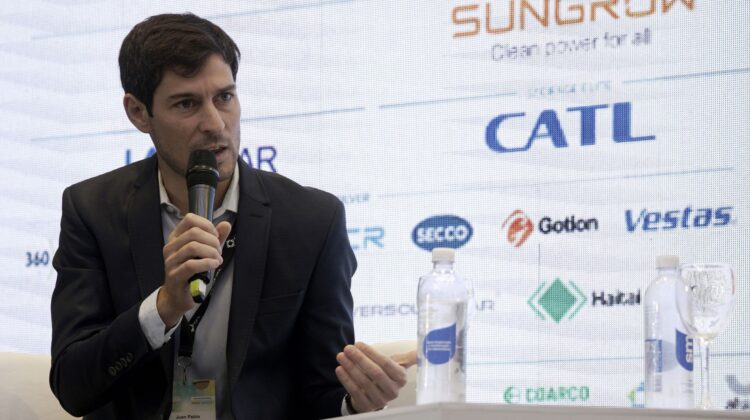
“Today we have only a few megawatt-hours installed on the grid, but we believe Alma GBA will deliver the major leap the energy storage industry has been expecting,” the executive said.
In this context, he stressed that battery energy storage systems (BESS) will be key to supporting the expansion of renewable generation within the power system. “We believe storage is an important tool to provide the flexibility the system needs — and will need even more as renewable penetration increases,” Alagia added.
Against this backdrop of potential expansion, 360Energy is already advancing its own projects to anticipate the development of the Argentine market. The company is working on initiatives that incorporate batteries into the electricity system, with engineering processes and procurement tenders already underway.
“We are close to starting our own projects. The detailed engineering is very advanced and we are already running tenders to award those 30 MWh,” Alagia explained.
Although the executive acknowledges that these projects are smaller in scale than the tenders being analysed by the government, he emphasised that the objective is to gain operational and technological experience during this new stage of the market.
The development of these initiatives also requires specific technical adjustments in the operation of the power system, particularly regarding measurement, control and monitoring mechanisms for stored energy.
“We are working closely with CAMMESA to determine how that energy will be measured, how it will be monitored and how the control systems will operate. It is somewhat different from the technical annex introduced last year for new energy storage generation agents,” said 360Energy’s Development and Technology Manager.
At the same time, the executive observes similar developments in other regional markets, where energy storage is also beginning to gain relevance on the energy agenda.
“I believe we are one step ahead of Brazil. We are also closely watching a tender similar to Alma SADI that is expected to be launched in Brazil but has been postponed several times,” he commented.
In that regard, Alagia added: “We are already quite advanced in Brazil’s renewable energy market and more recently we have begun exploring opportunities in Mexico.”
The company operates as an independent power producer (IPP) and sells electricity through various schemes, including private power purchase agreements (PPAs) and participation in Argentina’s wholesale electricity market.
One of the company’s recent focuses is the industrial self-consumption segment, where it already has projects in operation.
“We are finalising two projects. One major project has already been completed for self-consumption at the Fiat factory in Córdoba, where we installed 8 MW of solar capacity behind the plant and it has been operating for a couple of weeks. We are also progressing with a project at the El Palomar factory, entering a segment aimed at supporting industry, which is currently somewhat depressed but will need these projects when activity rebounds to generate its own power and achieve greater predictability and stability,” the executive explained.
Finally, the executive also referred to the current situation in the solar market, which is marked by volatility in equipment prices.
“Solar modules are currently in a very particular situation. Prices are about 50% higher than they were a year ago,” he said, stressing that the development of new renewable projects must be analysed from a broader perspective.
“Climate change is a reality. We see it in hailstorms, floods and severe weather events. Energy matrices must continue to diversify so that countries can grow,” he said.
He concluded: “Solar parks and hybrid projects are not built with modules alone. It is also necessary to understand how the battery market evolves and how to develop more efficient and competitive projects.”