












Paraguay is preparing a significant expansion of its power system to keep pace with rapidly growing electricity demand, which in recent years has exceeded historical trends and is forcing the country to add new generation capacity in the short term.
According to official estimates, Paraguay could require up to 800 MW of additional capacity in the coming years to supply both rising consumption and the arrival of new industrial projects.
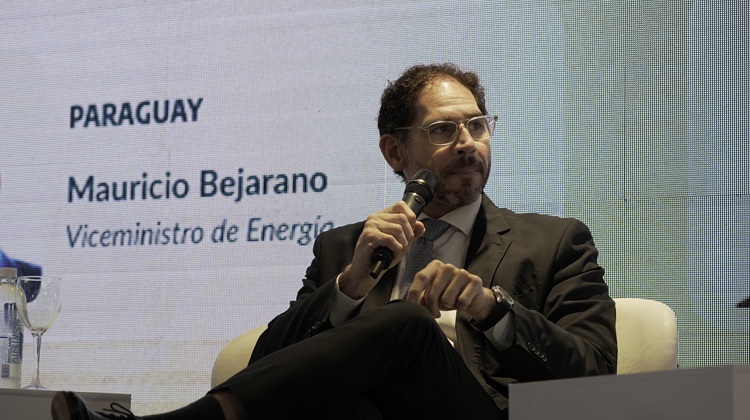
“The private sector will be the major player in Paraguay from now on,” said Mauricio Bejarano, Vice Minister of Mines and Energy, during the Future Energy Summit (FES) Argentina, where he outlined the government’s strategy to mobilise capital toward new power generation projects.
Bejarano explained that the Master Plan of Paraguay’s state utility, Administración Nacional de Electricidad (ANDE), foresees an annual expansion of 400 to 500 MW of generation capacity. However, that figure could increase due to the rapid growth of large industrial consumers.
“There is an additional need for 200 to 300 MW that we will have to deploy to serve the large industries that are expected to arrive,” the vice minister said, noting that this estimate excludes demand from so-called convergent industries.
To facilitate investment in new generation projects, the government is introducing several regulatory mechanisms designed to improve project financing conditions.
Among them are power purchase agreements (PPAs) with terms of up to 30 years, along with the possibility of project transfers and consortium participation, structures aimed at enabling developers and financial institutions to participate in the country’s emerging power market.
These instruments are expected to accelerate investment in renewable energy and other generation technologies needed to maintain grid reliability.
One of the most important milestones in this strategy will be Paraguay’s first large-scale solar PV auction, which will award a 140 MW photovoltaic project in the Chaco Central region.
The tender will be launched once the regulatory framework under the country’s renewable energy promotion law is fully implemented.
“We are required to launch the tender before mid-year,” Bejarano said, adding that the solar project could enter commercial operation between 18 months and two years after the award.
According to the vice minister, project economics remain attractive for developers.
“Solar projects can be installed at USD 50–60 per MWh, which suggests there is significant profitability and that this range represents a viable entry point into the market,” he explained.
The urgency to launch new tenders and generation projects is largely driven by strong growth in electricity demand.
Electricity consumption increased 18% in 2024 and is expected to rise 12.5% in 2025, far above Paraguay’s historical growth rate of around 7% annually.
This accelerated expansion is quickly reducing the country’s available reserve margin, making new generation capacity essential to maintain system reliability.
In response, the government is promoting a structural shift in Paraguay’s electricity sector, which has historically been highly centralised under ANDE.
A key component of this transformation is the Renewable Energy Promotion Law (Law No. 6977/2022), which establishes new participation mechanisms for independent power producers (IPPs), investors, and project developers.
The reform also introduces new electricity commercialisation models, including:
-
Direct power supply contracts with large consumers above 30 MW
-
Self-consumption projects developed by industrial users
-
Distributed generation systems below 1 MW
Under the distributed generation framework, ANDE must purchase surplus electricity generated by self-producers, a segment that could expand rapidly in Paraguay’s metropolitan areas.
Regional integration and export opportunities
Paraguay’s energy strategy also includes strengthening its position within South America’s regional electricity markets.
The country already maintains major power interconnections with Brazil and Argentina, primarily through binational hydroelectric projects such as Itaipu and Yacyretá. Authorities are now evaluating the possibility of expanding energy trade with Bolivia through future interconnection infrastructure.
“We have the possibility to export electricity because a new market like Bolivia could open, and there is a real opportunity for interconnection in the near future,” Bejarano said.
Regional infrastructure projects, including the Bioceanic Corridor highway, could also stimulate industrial development in Paraguay’s Chaco region, increasing electricity demand and creating new opportunities for renewable energy, firm generation, and grid expansion.