








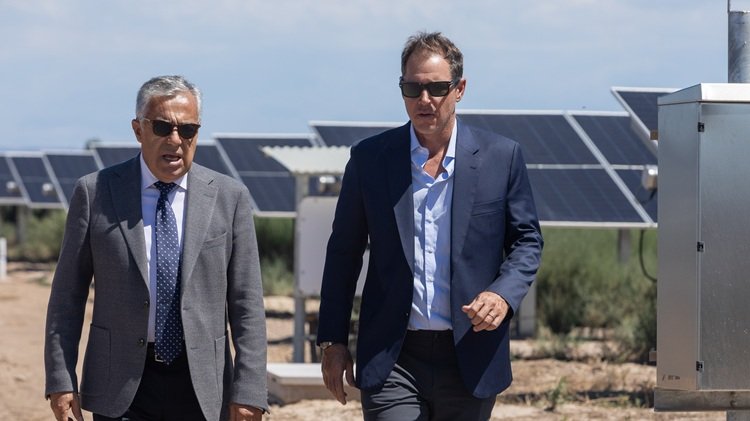
Genneia is preparing a new 365 MW solar PV park in Mendoza with a 2029 horizon, a project that could become Argentina’s largest solar plant. The investment is expected to exceed USD 300 million and may be structured under the Large Investment Incentive Regime (RIGI), a federal framework aimed at attracting large-scale investment.
The initiative is part of a provincial strategy designed to consolidate 1 GW of installed renewable energy capacity in Mendoza.
“The Mendoza Sur – Diamante park still needs to be fully sized, and discussions are ongoing, but it will exceed 360 MW, which implies an investment of more than USD 300 million,” revealed Jorge Brito, Chairman of Genneia, during the inauguration of another 180 MW project attended by Energía Estratégica.
“Our goal is to reach 1 GW of installed capacity in the province. We are expanding new private contracts, which increase Mendoza’s productive capacity,” he stated.
Anchoris solar park – 180 MW of capacity
The remarks by the banker and former president of River Plate were made during the official inauguration of the 180 MW Anchoris solar park, which required an investment of USD 160 million, incorporates 360,000 bifacial modules and is expected to generate 497 GWh annually — equivalent to the electricity consumption of 125,000 households.
With this project, Genneia reaches approximately 1.4 GW of installed renewable capacity and expects to close 2026 with 1.7 GW, of which nearly 800 MW will be located in the Cuyo region following the commissioning of Anchoris and the upcoming start of operations at San Rafael (140 MW by the end of May) and San Juan Sur (129 MW).
“We are highly focused on private contracts. All this additional supply we are generating is being channelled through private agreements,” Brito insisted, referring to the growth of contracts under Argentina’s Renewable Energy Term Market (MATER), which enables bilateral power purchase agreements (PPAs) between generators and large users.
The expansion of the project pipeline is not driven solely by traditional corporate demand. The company views mining as a “very important vertical” for upcoming developments, to the extent that its chairman indicated there is a project “at a very advanced stage” in Mendoza combining renewable generation and high-voltage transmission infrastructure to supply copper extraction operations.
What is the current status of renewables in Argentina? The country has 7,843 MW of installed renewable capacity in the Wholesale Electricity Market (MEM), excluding large hydroelectric plants. Meanwhile, MATER records 85 projects totalling 3,646.5 MW with dispatch priority, and a further 51 projects representing more than 2,300 MW awarded but still pending commercial operation. This highlights that coordination between renewable generation, energy storage and private PPAs will be decisive for the sector’s expansion.
In this context, Energía Estratégica has launched the special report “Argentina Redefines Its Energy Market: Companies, Projects and Opportunities under the Milei Administration”, a document mapping the leading companies driving renewable development in the country. It analyses a project pipeline exceeding 10 GW across operational, awarded and various evaluation stages, and examines how corporate leadership is being reshaped under a scheme increasingly oriented towards bilateral contracts.
The report also identifies economic groups with the greatest expansion capacity and the entry of new international players evaluating investments in renewable generation and energy storage under the redesign of the Wholesale Electricity Market.
Energy storage as a new business model
Energy storage is emerging as another structural growth pillar, following the award under the AlmaGBA tender of a 40 MW BESS project in northern Buenos Aires (with commercial operation expected by year-end) and pending further calls.
“Genneia has an obligation to lead in new renewable technologies, so we are indeed looking at batteries,” said Bernardo Andrews, Chief Executive Officer of Genneia, when asked about the issue after the inauguration of the Anchoris solar park.
Attention is now focused on the imminent national AlmaSADI tender, which is expected to allocate between 600 MW and 700 MW of BESS capacity to replace forced generation at different nodes of Argentina’s grid.
“We expect tender documents to be released soon. We will study them carefully and should be ready to continue contributing solutions to the system — particularly cost-competitive solutions that can be built quickly, as the system is highly constrained,” the executive stated.
However, he warned about external variables impacting costs, including the international economic and political context and tax measures adopted by leading manufacturing countries.
“China’s position as an exporter of components is adding uncertainty, because it previously had an export VAT rebate process that no longer exists. Therefore, we must analyse at what cost competitive solutions can be offered to the system,” he explained.
“There is a degree of uncertainty in the market at the moment, due to component issues and regulatory changes, and Genneia must lead and act with agility to manage this uncertainty,” he concluded.
With a new 365 MW solar project under evaluation, a 1 GW target in Mendoza, expansion linked to mining demand and an active strategy in energy storage, Genneia is deepening its position in Argentina’s renewable energy market under a framework driven by private PPAs, fiscal stability mechanisms and structural growth in new business models towards 2029.