











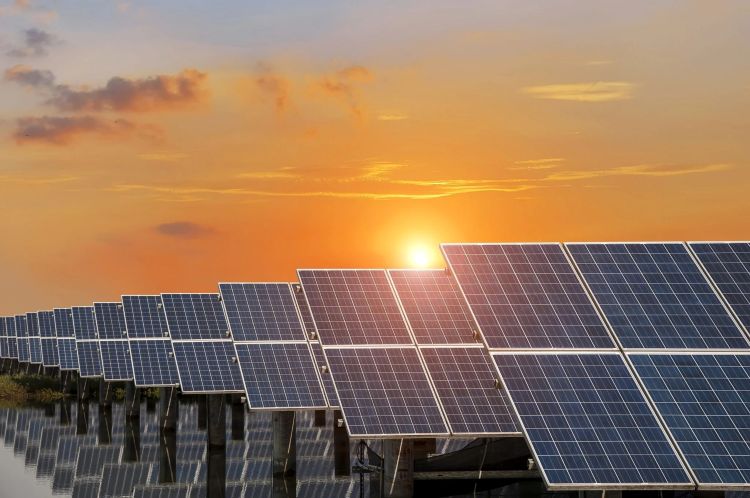
The Dominican Republic is set to reach 1,907.48 MW of installed solar PV capacity by 2027, while wind power is projected to total 582.15 MW, bringing non-conventional renewable energy (NCRE) capacity to 2,544.63 MW overall, according to a report by AABI Group.
By 2025, total installed capacity stands at 7,120.13 MW, marking an 18.96% year-on-year increase. Solar PV already accounts for 22.20% of the system, with 1,580.96 MW connected to the National Interconnected Electricity System (SENI).

Expansion is not limited to utility-scale plants. An additional 536.69 MW operates under the country’s net metering scheme, installed by more than 22,790 users. This reflects steady growth in distributed generation and a gradual decentralisation of power supply.
Solar development has followed a consistent upward trajectory. From Monte Plata Solar (30 MW in 2016) to more recent projects such as Mirasol (100 MW in 2024), the country has consolidated a strong renewable energy pipeline.
In 2025 alone, major projects entering operation include:
-
Washington Capital 2 and 3 (100 MW)
-
Cotoperí I, II and III (144 MW)
-
Coastal (110 MW)
-
Peravia I and II (140 MW)
-
Cumayasa 4 (50 MW)
“The net increase of 1,134.78 MW during the year is due to the commissioning of strategic projects,” AABI Group stated.
The pipeline remains active. Projects scheduled for 2026 include Payita II (50 MW), Monte Plata Phase II (30 MW), Cabreto 1 (50 MW), Levitals (40 MW) and Villarpando (100 MW). In 2027, Dominicana Azul I (101 MW) is expected to come online.

“Solar PV will remain the dominant technology, representing 75% of projected renewable capacity by 2027,” the report underlined.
This deployment is underpinned by a structural decline in capital expenditure (CAPEX). Average investment costs have fallen from USD 6,200–6,500 per kW in 2011 to around USD 900 per kW in 2025 — a reduction of more than 80%, even after fiscal incentives were scaled back.
Lower CAPEX has significantly improved the levelised cost of electricity (LCOE), reinforcing solar PV’s competitiveness against thermal generation and attracting sustained investment in renewables.
BESS becomes essential to sustain growth
Installed capacity does not automatically translate into effective generation. Although renewables account for 38.15% of total capacity, their actual contribution in 2025 was 19.99% of electricity produced, compared to 39% from natural gas and 28.7% from coal-fired power.
“Excess renewable generation that cannot be integrated into the grid in real time has generated adverse economic impacts,” AABI Group warned.
Between January and December 2025, curtailed energy reached 189,082 MWh, with estimated losses of USD 30.25 million. In December alone, losses peaked at USD 14.15 million.
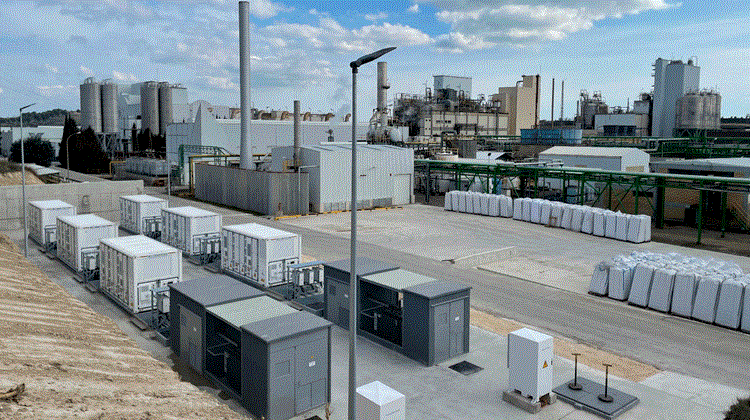
Currently, more than 1,300 MWh of storage capacity is operating under non-PPA (power purchase agreement) schemes. However, a turning point is expected with the planned 600 MW (nominal) BESS tender scheduled for May 2026.
The operational and financial rationale is clear: capture excess solar generation during low-demand hours and dispatch it during the evening peak, reducing marginal costs and displacing less efficient thermal generation.
The challenge is compounded by accelerating electricity demand. Peak demand growth has surged from 30 MW annually (2001–2014) to 170 MW per year between 2015 and 2025, with nearly 800 MW added over the past three years alone.
With 6,052.73 km of transmission lines, grid infrastructure will be decisive in integrating renewable energy and energy storage without compromising reliability or system stability.
The expansion is already underway. The real test for the Dominican power system by 2027 will not simply be reaching nearly 2 GW of solar PV capacity, but transforming that capacity into dispatchable, economically efficient generation through large-scale battery energy storage and enhanced grid integration.