










Mexico has formally launched a new public–private investment framework aimed at adding 7.5 GW of renewable generation capacity by 2030, marking one of the country’s most significant clean energy initiatives in recent years.
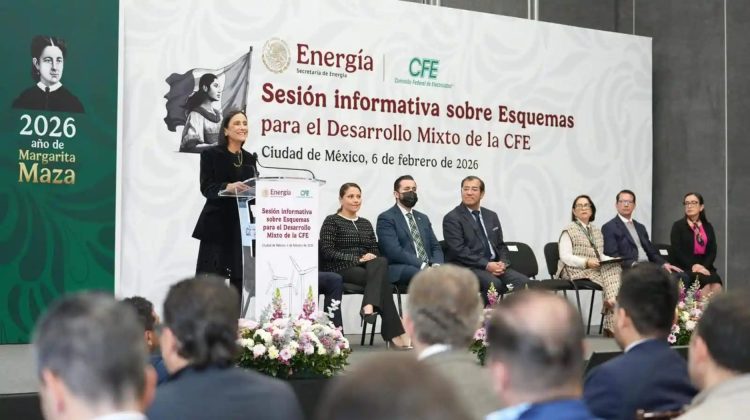
The scheme, known as Mixed Development Structures, was presented by Comisión Federal de Electricidad (CFE) and the Secretaría de Energía, with the goal of accelerating investment in utility-scale solar PV, wind power and concentrated solar power (CSP).
At the core of the model are power purchase agreements (PPAs) of up to 25 years, under which CFE will act as the offtaker for most of the electricity generated. The public utility will contribute land, permitting management, project operation and grid integration, while also committing to purchase 70% of the output under long-term contracts.
Private investors, for their part, will provide 100% of the equity capital, as well as undertake construction and part of the technical development. The resulting ownership structure allocates 54% of equity to CFE and 46% to the private partner, ensuring public control while mobilising private investment.
The remaining 30% of generation may be sold to third parties or into the wholesale electricity market, offering additional revenue streams and improving project bankability.
Projects will be financed through a mix of equity and debt, with 20–30% equity and 70–80% debt, in line with international standards for utility-scale renewable energy projects. The investment vehicle will include binding agreements such as trusts, capital contribution contracts, EPC contracts, operation and maintenance (O&M) agreements and management services.
According to the Energy Ministry, the contractual design includes safeguards to ensure that assets and liabilities are not consolidated onto the State’s balance sheet, while strategic control remains in public hands.
“The guidelines of this new framework establish clear rules that provide legal certainty for private investment,” said Luz Elena González Escobar, Mexico’s Secretary of Energy.
The renewable portfolio is embedded in Mexico’s 2026–2030 Infrastructure Investment Plan for Development and Wellbeing, which foresees total spending of MXN 5.6 trillion, with the energy sector accounting for 54% of the overall budget. The government sees energy infrastructure as a key driver of economic growth, energy security and decarbonisation.
The call for proposals includes a regionalised portfolio of 6.5 GW, complemented by projects already under development by CFE. Priority technologies are solar PV, onshore wind and CSP, distributed across seven regions:
-
Northwest: 1,000 MW of solar PV
-
Northeast: 2,260 MW (70 MW solar PV and 2,190 MW wind), the largest wind cluster in the scheme
-
Western region: 1,540 MW (1,140 MW solar PV and 400 MW wind)
-
Eastern region: 600 MW (400 MW solar PV and 200 MW wind)
-
Northern region: 270 MW of solar PV
-
Peninsular region: 470 MW of solar PV
-
Baja California: 360 MW (200 MW solar PV, 100 MW CSP and 60 MW wind), the only region including solar thermal technology
In addition, CFE is advancing two strategic solar PV projects: Concepción Mendizábal (858 MW) in the Northeast and Cerro Prieto (215 MW) in Baja California, currently under construction. Together, they represent 1,073 MW of additional capacity already in the pipeline.
The tender process includes stringent evaluation criteria, with emphasis on:
-
Proven experience in renewable energy and energy storage projects
-
Technical and financial capacity
-
Project maturity (ready-to-build status)
-
Corporate governance structure
-
Economic model and indicative internal rate of return (IRR)
-
Ability to absorb additional risks and contingency costs
Registration for interested companies is open until 20 February through Mexico’s Single Energy Window. Developers must submit technical and financial documentation, permits in progress, environmental and interconnection studies. This will be followed by technical review, proposal submission, evaluation, contract signing and financial close.
Construction is expected to begin in November 2026, with projects entering commercial operation between 2028 and 2029.
The scheme complements CFE’s recent announcement of an additional MXN 29 billion investment to deploy more than 1.56 GW of renewable generation and energy storage, reinforcing the government’s strategy to move towards a cleaner, more resilient and decentralised power mix.
Market data show that Mexico has already awarded over 3.3 GW of renewable projects and 1.2 GW of battery storage in the latest private-sector tender. While expectations remain high, industry players continue to call for improvements in permitting timelines, PPA bankability and technical specifications.
“We invite all energy sector stakeholders to submit their proposals, without excluding anyone,” González Escobar said, speaking alongside representatives from development banks and business associations.