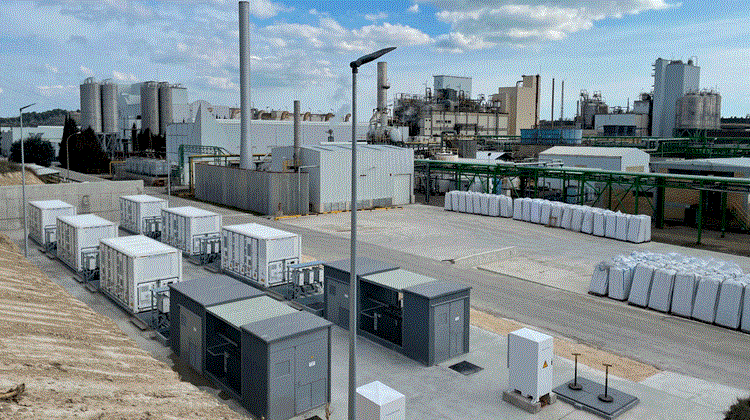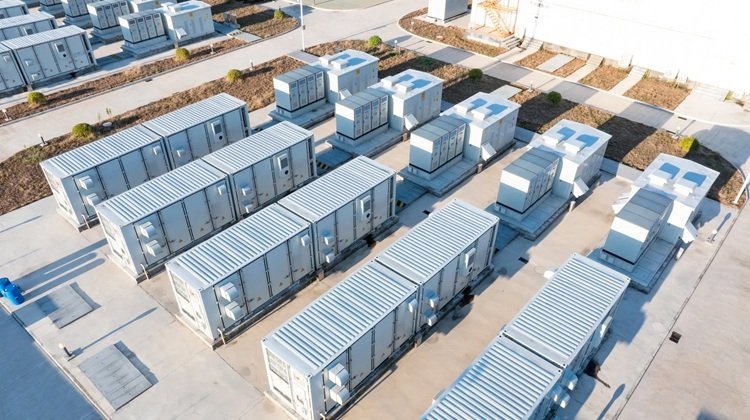











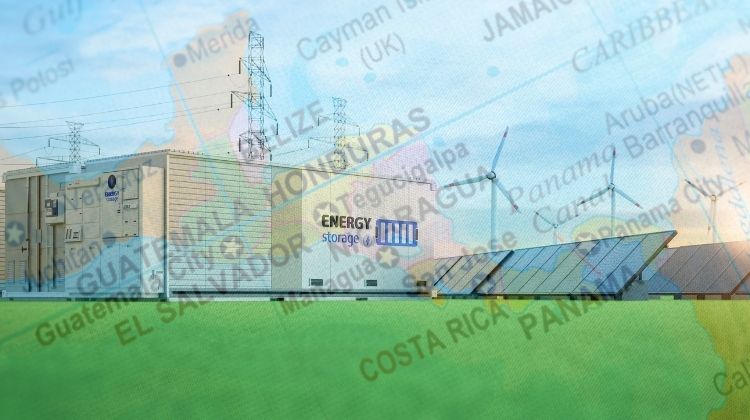
Central America and the Caribbean have entered a decisive phase for integrating energy storage into their power mix. Guatemala, Panama, Dominican Republic and Honduras are currently running tender processes that together exceed 4,000 MW and already include BESS either as a mandatory requirement or as a strategically valued component.
The direction of travel is clear: new power plants are expected not only to generate electricity, but also to actively manage it—providing flexibility, reliability and grid support in systems with growing renewable penetration.
However, Leonardo David, a specialised consultant, warns that the prevailing contractual model in the region remains inadequate to attract large-scale investment in storage.
According to his analysis, “traditional PPAs driven by a race-to-the-bottom logic and spot market energy arbitrage rarely generate sufficient revenue to justify a battery on their own”. Key services such as capacity management, system backup and fast demand response are typically not remunerated. Under these conditions, David argues, it is not financially viable to deploy storage—even when tender documents explicitly require it.
Honduras provides a clear example of this mismatch. In November, the new government reactivated a 1,500 MW tender that includes a technical requirement for storage equivalent to 20% of each project’s installed capacity. While the move has been welcomed as a positive signal for the market, it has also raised concerns among developers.
From David’s perspective, the issue is not the obligation to include BESS, but the fact that contracts fail to reflect the value these systems bring to the power system as a whole.
This challenge is not unique to Honduras. In the Dominican Republic, Guatemala and Panama, new tenders are also being launched that allow or encourage the integration of storage, largely in response to the need for greater system flexibility as solar PV and wind power expand. In most cases, however, there are still no specific contractual mechanisms or dedicated markets to remunerate availability, capacity or ancillary services.
From a financing standpoint, the lack of diversified revenue streams directly affects bankability. David explains that batteries require a more complex income structure than standalone solar or wind projects. Their business case depends on multiple revenue sources, including:
-
Energy sales
-
Capacity payments
-
Grid and ancillary services
-
Active participation in system operation
When PPAs recognise only one of these components—typically energy—the business model becomes incomplete and, in many cases, unbankable.
Rethinking market design
To address this gap, David suggests moving towards schemes that better capture the real value of storage, such as contracts for difference (CfDs), capacity markets or explicit payments for grid services. He also stresses that greater market openness is essential to unlock new investment, particularly in countries where electricity trading remains highly concentrated in state-owned utilities.
In this context, he argues that Honduras could benefit from a more segmented market structure, where the state-owned utility ENEE focuses on regulated consumers, transmission and distribution, while competition is enabled among generators and large consumers.
“Creating a category of qualified consumers, as already exists in Panama or Guatemala, would be a decisive step,” David notes. In both countries, this regime applies to customers with monthly peak demand above 100 kW, although the appropriate threshold for Honduras would need careful assessment.
He also considers allowing private transmission lines as a viable option, so that ENEE’s financial constraints do not delay or block contract execution. In his view, a full privatisation of the utility would be chaotic, but a mixed model—where a state company coexists with private operators—could work, as seen with INDE in Guatemala.
Storage is no longer optional
Despite persistent regulatory barriers, private sector interest remains strong. Ongoing tenders in Guatemala and the Dominican Republic, with defined timelines and institutional backing, are already generating momentum among developers and multilateral banks.
Yet the core question remains unresolved: how can financing be secured for BESS-backed projects if contracts do not reflect their true technical and system value?
According to David, the answer lies in aligning technical requirements with modern, flexible contractual structures. Energy storage is no longer an option—it is becoming a condition. The next challenge is to ensure it also becomes a viable investment.