










Clou ESS, a China-based company with a long track record in battery energy storage systems (BESS), is moving ahead with a sustained expansion strategy across South America. The plan is anchored in operating assets, active participation in public tenders and the rollout of new storage technologies tailored to different market needs.
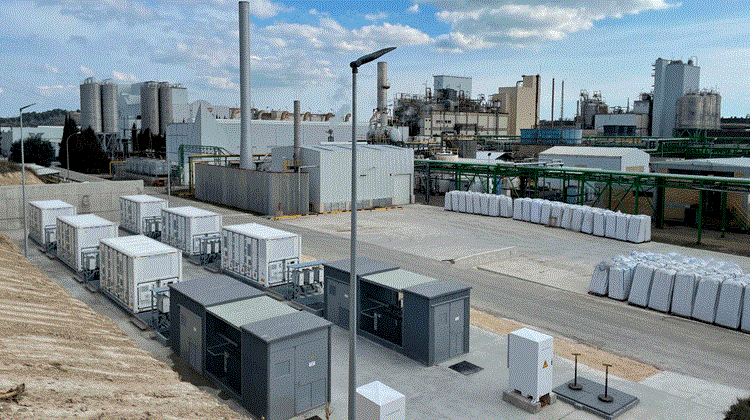
Chile has emerged as Clou ESS’s main operational market in the region. The company is currently involved in a 105 MW / 420 MWh project in the Copiapó area, as part of a large-scale solar complex owned by the COPEC Group and developed by Transelec. Additional installations are already scheduled for 2026, reinforcing the country’s role as a cornerstone of Clou ESS’s South American portfolio.
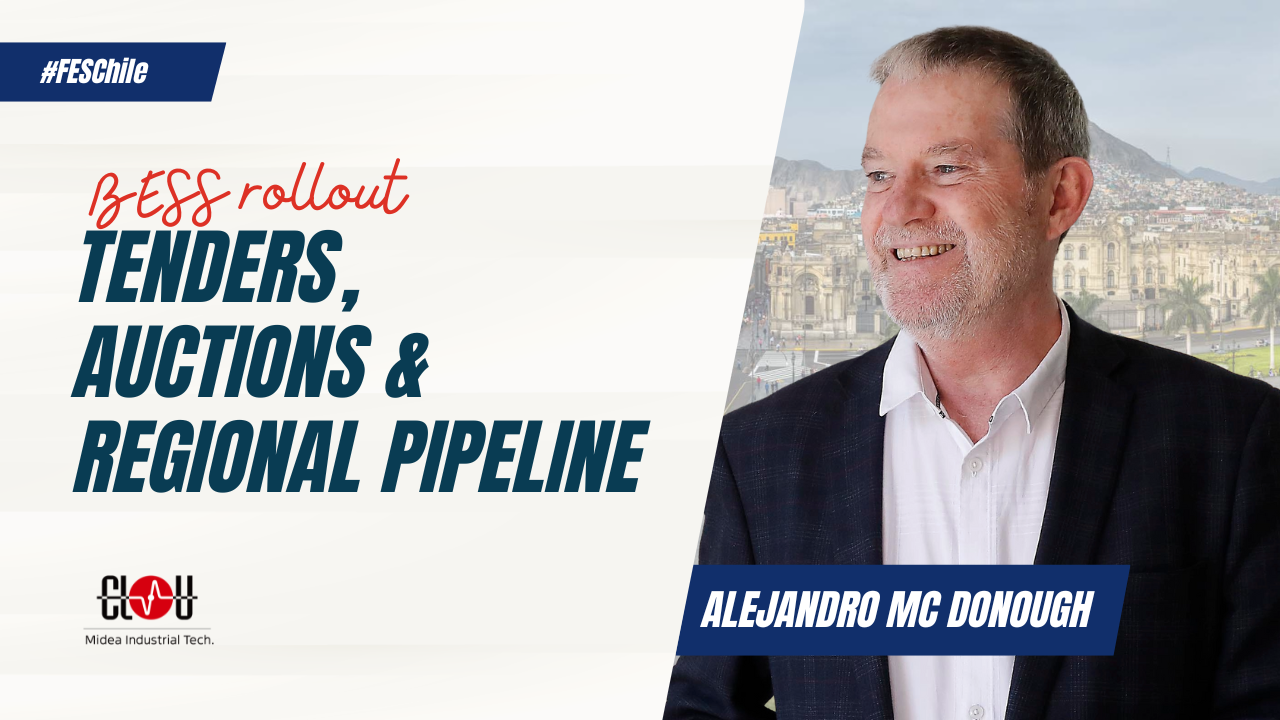
“The projects we have in Chile are very strong, but we want to grow even further,” said Alejandro Mc Donough, the company’s CEO for Latin America, in an interview conducted during Future Energy Summit Chile.
In the same Copiapó region, Clou ESS is also developing a hybrid PV+BESS project that foresees an expansion of storage capacity from 210 MWh to 310 MWh by January 2026, underscoring the growing role of batteries in supporting grid integration and renewable energy dispatch.
In Argentina, the company is positioning itself as a supplier for projects awarded under the AlmaGBA tender, which allocated 713 MW of new capacity to be installed in the Buenos Aires Metropolitan Area. This follows Clou ESS’s execution of a 63 MWh PV+BESS system in the province of Catamarca.
“The AlmaGBA tender required a great deal of attention from us. It is a very good opportunity and could open the door to future calls in the country,” Mc Donough noted. “We are closely monitoring the process, first to secure contracts and then to expand into other areas.”
Watch the full interview with Alejandro Mc Donough: https://www.youtube.com/watch?v=AGTpERf0ZF4
Meanwhile, in Brazil, Clou ESS is closely tracking the country’s first auction dedicated exclusively to battery energy storage systems, known as LRCAP 2026 – Storage. The scheme was opened for public consultation in November last year and is scheduled to take place in April 2026.
“Brazil could really take off this year, and that is what we are aiming for,” the regional CEO said, adding that the company is also holding discussions in Colombia, Mexico and Costa Rica as part of its broader strategy to consolidate a regional footprint.
Flexible business models and new BESS solutions
With more than 20 years of experience in energy storage, Clou ESS combines grid-forming technologies and advanced network control with a regional approach focused on technological adaptation and next-generation solutions. One of the pillars of its expansion lies in the flexibility of its systems to serve different revenue streams.
“A project may start as an energy arbitrage business and later become a provider of ancillary services. We have technology that allows us to address any of these applications,” he explained.
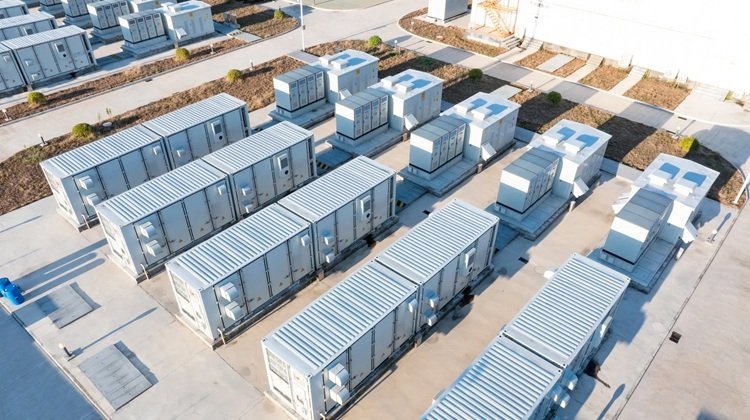
This regional rollout is supported by a renewed technology roadmap, including the Aqua C 1.0, 2.5 and 3.0 product lines, designed for industrial applications, distributed generation and utility-scale projects. The recently launched Aqua C 3.0 features 3.2 MWh and 3.8 MWh versions, battery capacities ranging from 584 to 614 Ah, liquid cooling, active balancing, optimised architecture and enhanced digital integration.
“We have already launched the Aqua C 3.0 solution to the market, and we expect to begin delivering these systems in early 2026,” Mc Donough said.
The company is also developing a DC version, with containers shipped pre-configured from China. This approach simplifies on-site installation and commissioning, significantly reduces cabling requirements and lowers overall project costs—an increasingly important factor as Latin America accelerates investment in utility-scale battery storage and hybrid renewable energy projects.