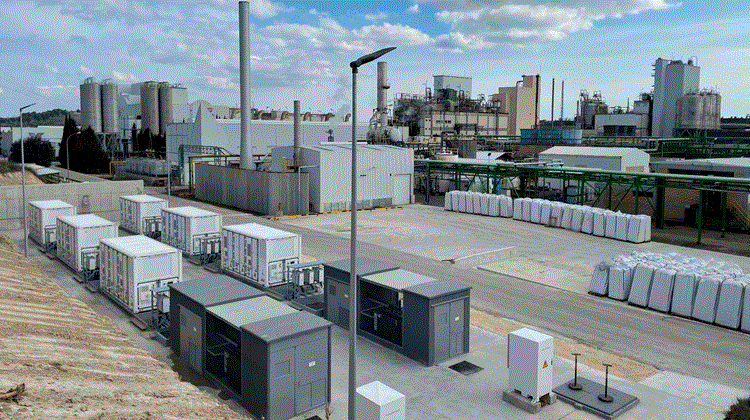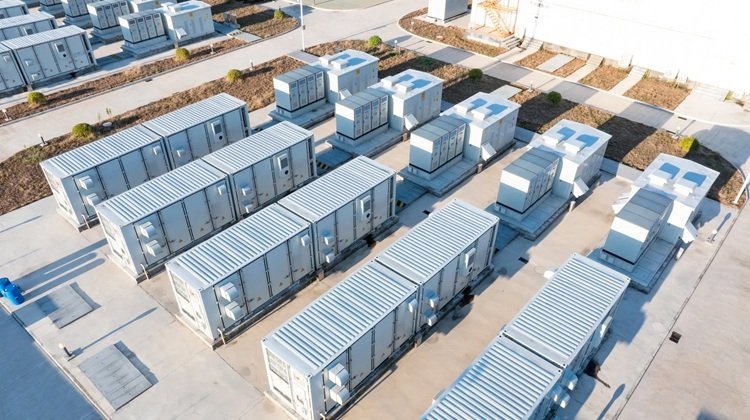












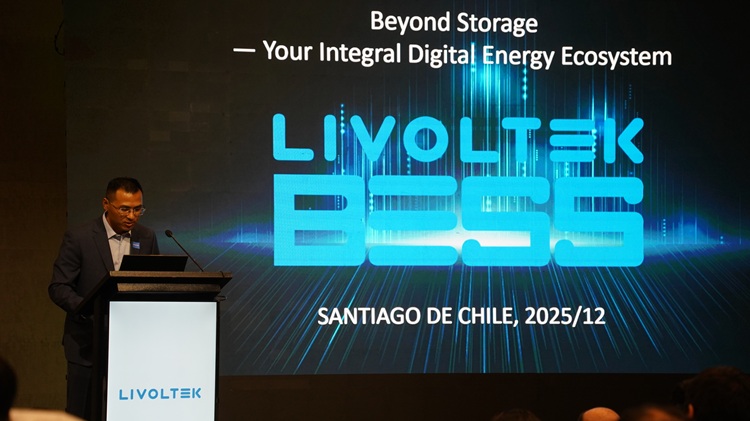
Livoltek, the global renewable energy brand of Hexing Group, officially launched its battery energy storage system (BESS) solutions in Santiago de Chile, presenting a modular, scalable and AI-managed platform designed to address the region’s growing energy and grid challenges.
The base configuration starts at 125 kW / 261 kWh, but can be expanded in parallel up to 1.25 MW and 2.61 MWh, enabling deployment across a wide range of use cases—from mid-sized facilities to large-scale industrial operations.
“We can deploy the systems in parallel, for example with a subsystem of up to 10 units. Combined with the EMS, this allows us to scale from 125 kW multiplied by 10, reaching megawatt-level capacity,” explained Zhao Qunfei, Business Line Manager at Livoltek.
A key differentiator of Livoltek’s solution is its artificial intelligence-driven Energy Management System (EMS), which continuously analyzes real-time load curves, defines operating thresholds and automatically executes charging and discharging cycles.
“With AI-based technology, sensors analyze energy consumption and verify the load curve. We then calculate the threshold: above it, the system discharges; below it, it charges,” Qunfei detailed.
This operating logic helps extend battery lifetime, avoids system oversizing and—according to company estimates—can reduce operating costs by up to 30%.
Livoltek develops internally the three core components of its BESS architecture, known as the 3S system:
-
PCS (Power Conversion System)
-
BMS (Battery Management System)
-
EMS (Energy Management System)
This full hardware-software integration enables smoother interoperability, higher overall efficiency and greater flexibility across applications, including:
-
Self-consumption
-
Peak shaving
-
Energy arbitrage
-
Backup power
-
Weak grids and microgrids
-
Virtual Power Plants (VPPs)
-
Transformer capacity management
Strong business case and regional expansion
From a financial standpoint, Livoltek estimates a return on investment (ROI) of three to four years, depending on application type, tariff structure and customer load profile.
Qunfei also emphasized the value of storage as reliable backup power for industrial processes, where grid outages can result in significant productivity losses.
“The commercial and industrial (C&I) segment is well suited for multiple scenarios, such as peak shaving, arbitrage or power regulation, including participation in virtual power plants,” he said.
In dynamic electricity markets—such as Europe, where prices can fluctuate every 15 minutes—the AI-driven EMS adapts in real time to maximize economic value by interfacing with VPP platforms and responding to price signals.
In Chile, the solution is particularly attractive due to high demand charges, renewable curtailment and grid constraints, positioning BESS as a cost-efficient alternative to traditional network investments.
Looking ahead, Livoltek expects strong regional growth, supported by subsidiaries, warehouses and manufacturing facilities already established across Latin America.
“By 2035, energy storage capacity in Latin America could reach up to 45 GW, creating significant opportunities in countries such as Brazil, Chile, Argentina and Mexico,” Qunfei noted.
“We know Latin America is a major growth market. We are ready to be a reliable solutions provider, working with partners to support grid development and deliver mutual benefits,” he concluded.