







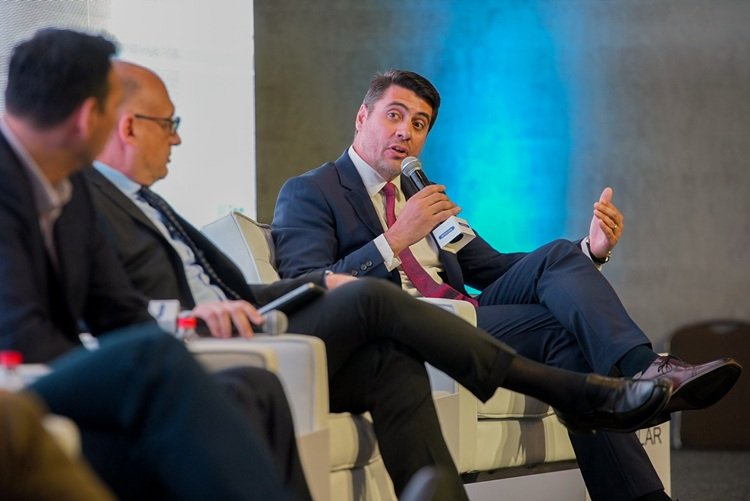
Chile’s energy transition is facing a new challenge: activating electricity demand to sustain the pace of investment and technological reconversion. This was highlighted by Juan Villavicencio, CEO of Engie Chile, during his participation in the Future Energy Summit Southern Cone.
“If we do not have more demand, it will not be possible to continue investing in this transformation,” the executive warned.
In his view, the energy transition cannot be sustained solely by adding new renewable generation capacity. Higher electricity consumption is essential, particularly in sectors such as mining, industry and transport.
Watch Juan Villavicencio, CEO of Engie Chile, at the Future Energy Summit Southern Cone here: https://www.youtube.com/watch?v=dcqxLQGp3SE
From Engie’s perspective, the commitment to decarbonisation is already underway. The company will close all its coal-fired units by 2026, starting next year with a 1 GW power plant in Mejillones. The focus is not only on dismantling infrastructure, but on transforming it. Some of these assets are being repurposed to host battery storage systems, while others will serve as thermal back-up.
The company already has more than 400 MW of battery energy storage in operation, with five hours of storage duration, representing a qualitative leap in flexibility and system management capacity. These projects are complemented by plants that will operate on natural gas, a technology that Villavicencio defended as necessary back-up to ensure security of supply at this stage.
“We need to think about a flexible power mix. Without back-up, we will not have security of supply or long-term viability for renewables,” he explained.
In this sense, he stressed that transforming the power system is not just about replacing one technology with another, but about designing a model that is economically viable, flexible and secure.
In addition to technological reconversion, the CEO warned about structural barriers that continue to slow down the sector’s development. One of the main obstacles lies in permitting processes: lengthy procedures, lack of coordination between public bodies and a gap between political discourse and concrete actions.
“We talk endlessly about the energy transition, but we still face delayed permits and a lack of coordination. There is no coherence between rhetoric and reality,” he criticised.
He also underlined that bottlenecks in transmission infrastructure put the entire energy planning process at risk.
This is compounded by concerns over the economic signals currently delivered by Chile’s electricity market. Villavicencio argued that the system is failing to recognise the value of key technologies such as energy storage and firm back-up capacity.
Some new projects are even at risk of being shut down due to a lack of clear incentives, while certain coal-fired plants continue operating because market prices allow it.
“Where are the right signals?” he questioned, warning that these distortions generate uncertainty for investors.
In his assessment, the energy transition requires coherent signals, clear rules and a pricing structure aligned with the transformation.
Engie’s vision is to advance a deep transformation of Chile’s energy system. But that transition, Villavicencio insisted, cannot be sustained without a solid base of electricity consumption: “It’s not just about generating clean energy. It’s about using it.”