











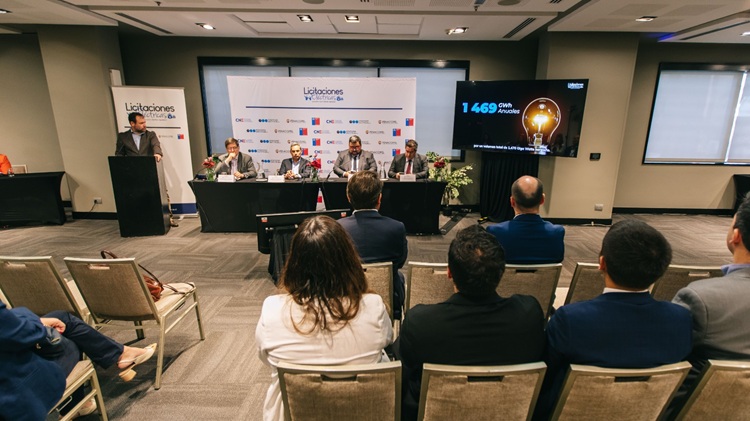
Chile has successfully completed its second exceptional electricity supply auction of 2025 (Tender 2025/02), awarding 1.47 terawatt-hours (TWh) per year to cover demand from regulated customers in 2026. The contracts were secured at an average price of US$98.699 per megawatt-hour (MWh), significantly below the reserve price set by the authorities.
The auction was awarded entirely to Enel Generación, which became the sole supplier for the tendered volume. The result highlights both the competitiveness of the process and the willingness of generators to participate in short-term supply schemes under Chile’s regulatory framework.
The tender was structured as a one-year supply contract, totaling 1,470 GWh, and divided into two delivery zones:
-
Zone 2: 298 GWh per year
-
Zone 3: 1,172 GWh per year
Each zone was further split into three hourly blocks, allowing contracts to better reflect the operational and demand profile of the Chilean power system and facilitating integration with system dispatch conditions.
A central element of the process was the inclusion of a Price Adjustment Mechanism, specific to exceptional short-term tenders. This mechanism allows the hourly contract price to be adjusted according to actual system operating conditions, reducing exposure to volatility, incentivizing participation, and enabling cost and benefit sharing between suppliers and end consumers.
Bid evaluation was carried out using an algorithm that compares the Levelized Price of each offer. This metric represents the present value equivalent of the bid price, taking into account its indexation formula.
For fuel price assumptions, the evaluation relied on public projections from the October 2025 Short-Term Energy Outlook published by the U.S. Energy Information Administration, ensuring transparency and consistency in the modeling framework.
The reserve price for the auction was set at US$129.108/MWh, equivalent to 1.5 times the energy component of the prevailing Market Average Price (PMM) at the time the tender was launched.
Although the awarded price was US$98.699/MWh, final payments by customers could be significantly lower. This is because the Price Adjustment Mechanism links the effective price to the system’s marginal cost, and current operational projections for 2026 anticipate low average marginal costs, subject to hydrological conditions and overall system performance.
High participation and market confidence
Despite its short-term nature, the auction attracted strong market interest. On December 2, seven companies submitted a total of 72 bids, representing 2.5 times the energy volume tendered.
Under the established rules, the winning portfolio was the combination of bids that minimized the weighted average Levelized Price across all zonal and hourly blocks, while simultaneously ensuring full coverage of the required supply.
Mauricio Funes, acting executive secretary of Chile’s Comisión Nacional de Energía (CNE), said the outcome confirms the effectiveness of the country’s electricity market design. According to Funes, the results demonstrate that existing regulatory mechanisms are capable of ensuring supply even under complex scenarios such as those anticipated for 2026.
He also noted that the prompt start of supply under these contracts reflects a high level of confidence among market participants in the certainty, transparency, and reliability of the procurement process.
Industry representatives highlighted the positive signal sent by the auction results. Juan Meriches, executive director of Empresas Eléctricas A.G., said the level of participation supports expectations of achieving a balanced mix of long- and short-term contracts, enabling regulated customers to access electricity at competitive prices.
Similarly, Patricio Molina, CEO of the National Federation of Electric Cooperatives (Fenacopel), emphasized that although demand was limited, the level of oversubscription clearly reflected market interest. He added that while the sector traditionally favors longer-term solutions, this initial experience confirms that exceptional short-term mechanisms can work effectively, providing certainty for both customers and suppliers.