








A recent resolution from Colombia’s Energy and Gas Regulatory Commission (CREG) — allowing battery storage systems to be formally integrated into the national grid — has reshaped the regional landscape for energy storage.
In response, Risen Energy has stepped up its Latin American strategy, expanding its offering through Risen Storage, targeting residential, commercial & industrial (C&I), and utility-scale segments.
With over 40 years of experience in the solar PV sector, the company is now positioning storage at the centre of its operations in the region, especially in countries where rapid solar deployment has outpaced grid infrastructure upgrades.
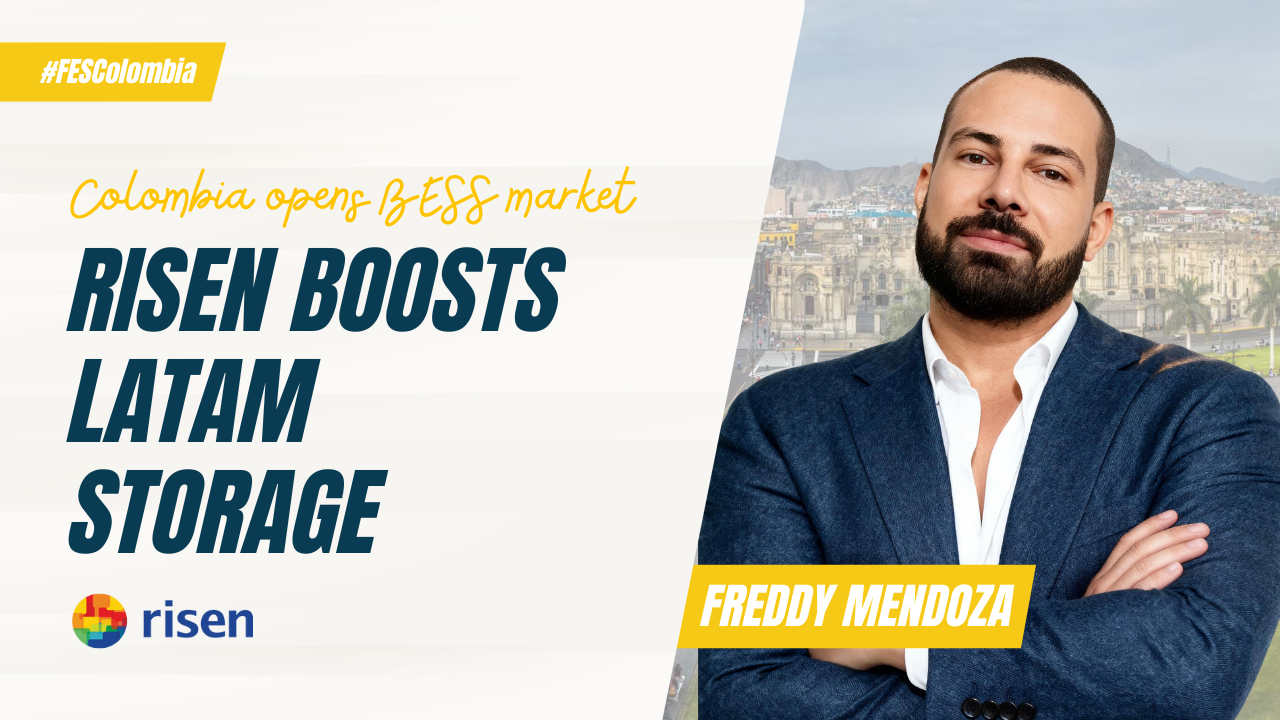
“We no longer see energy storage as a speculative asset. It is now an integral part of the system, enabling voltage control, secondary frequency regulation, and relief in areas of grid congestion,” explained Freddy Mendoza Berdella, Senior Sales Manager LATAM PV & BESS at Risen Energy, during the Future Energy Summit Colombia.
Watch the full interview here: https://www.youtube.com/watch?v=nprNT5BQjZ8
In markets like Colombia, where expanding transmission lines is a major hurdle, storage emerges as an immediate tool to alleviate operational bottlenecks without the need for large-scale infrastructure works. Mendoza noted that new business models are also emerging, such as storage PPAs that prioritise reliability over purely low-cost energy supply.
In this context, he summarised the company’s approach with a phrase that encapsulates the shift underway:
“Storage is no longer optional – it is a solution.”
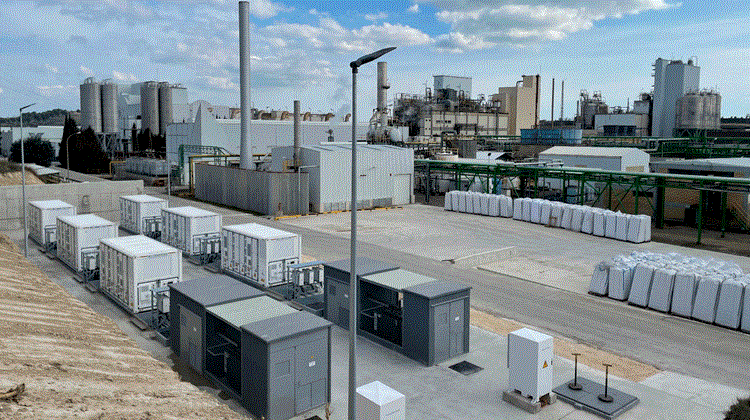
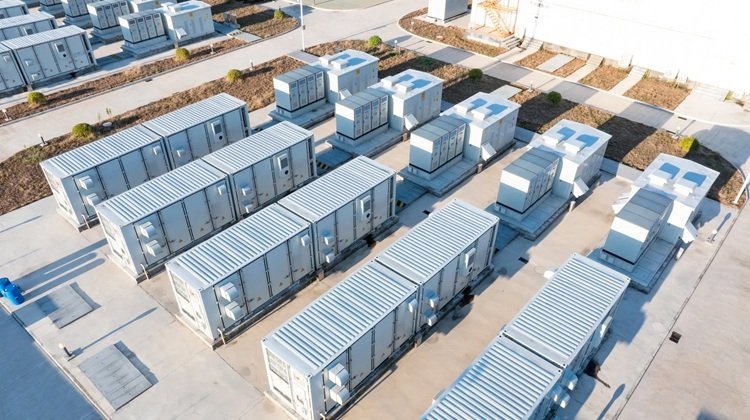
Risen’s strategy is backed by mature, stable technology — specifically lithium iron phosphate (LFP) batteries, known for their safety and durability. The systems deployed by the company offer more than 6,000 charge and discharge cycles, increasing bankability and investor confidence.
Yet the proposition goes far beyond hardware. Risen positions itself as a full-scope partner, offering after-sales service, technical support, and project lifecycle assistance. Mendoza highlighted that the company’s goal is not merely to ship equipment, but to provide added value throughout the chain.
This is reinforced by a digitalisation strategy that leverages artificial intelligence to streamline communication across technical, commercial and financial teams. The company has developed AI-powered agents capable of interpreting natural language and bridging gaps between developers and decision-makers — a critical capability in culturally diverse or geographically distant teams.
“Using natural language tools, we’ve closed the gap between developers and financial stakeholders,” Mendoza said.
This approach was recently applied to a landmark 400 MWh storage project in the United States, which now serves as a benchmark for upcoming Latin American deployments.
The growth of Risen Storage reflects a broader transformation in the Latin American energy market, where storage is becoming a core component of investment strategies, grid planning and long-term reliability frameworks.
The company confirmed it will continue to expand its presence across the region, deploying new technological and commercial solutions tailored to local regulatory frameworks and energy needs.
Events such as the Future Energy Summit Colombia, Mendoza added, are critical for identifying opportunities, aligning with new policy signals, and building the cross-sector dialogue needed to accelerate the energy transition.