





With eight manufacturing plants across South America and more than 100 renewable energy projects in its regional track record, Nexans is strengthening its position as a strategic player in the electrification of the future. The French company, which has 140 years of global experience, currently operates in Colombia, Peru, Chile and Brazil, where it has supplied cabling solutions for projects totalling around 9 GW of installed capacity.
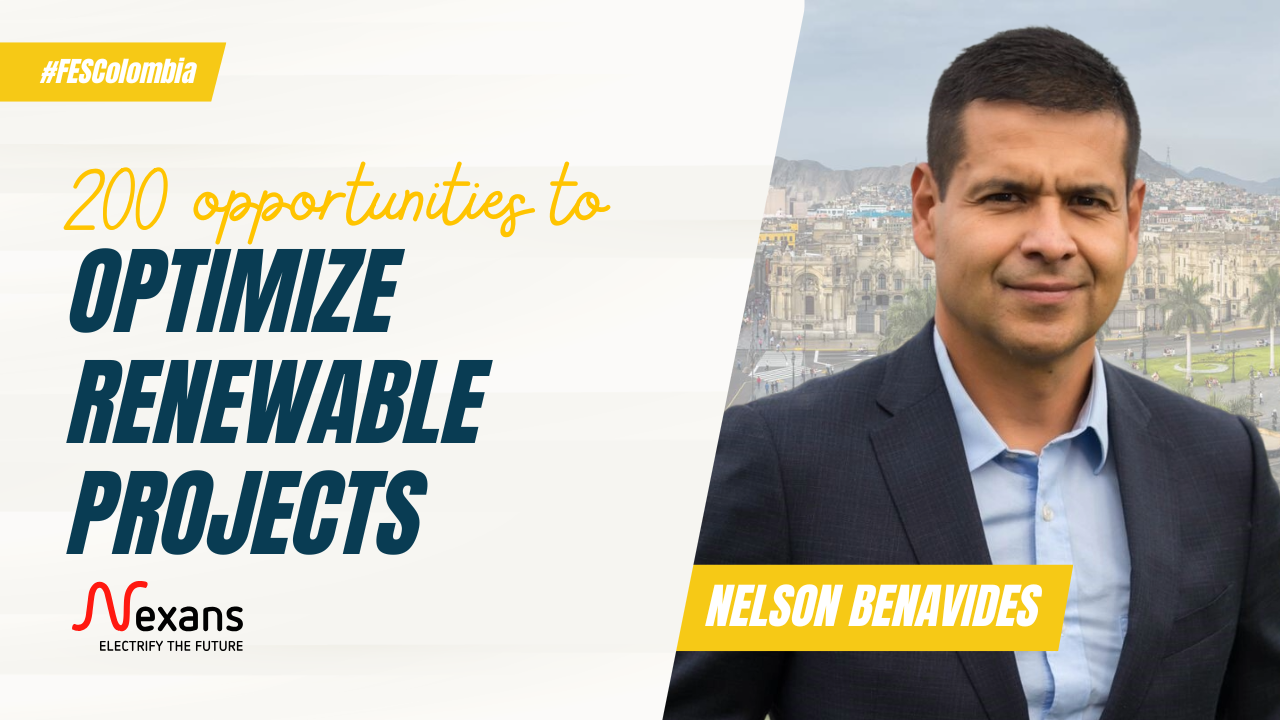
Speaking at the Future Energy Summit (FES) Colombia, Nelson Benavides, Renewable Sales Director for South America (SAM), explained how Nexans is reshaping its value proposition. The company’s goal is to move beyond being a traditional cable supplier and become a technical partner to engineering, procurement and construction (EPC) contractors, providing tools that directly improve operational efficiency.
Rewatch the full interview here: https://youtu.be/uLZ9CzBUvig
In 2023, Nexans carried out technical visits to 15 solar parks across the region, supported by specialists in social behaviour and on-site construction processes. The assessment identified more than 200 opportunities for improvement, mainly linked to installation tasks, component handling and waste management.
These findings led to the development of tailored solutions designed to optimise time and costs during construction. Among them are rollers, protective caps and solar cable carts developed by the company, which improve worker ergonomics, reduce on-site errors and enhance electrical safety during cable laying.
According to Nexans, these innovations also aim to professionalise processes that have traditionally been underestimated, despite their technical and operational importance. A cleaner and safer installation, the company argues, translates into more efficient projects with lower technical and financial risk.
Another key area of focus is waste and disposable material management at large-scale solar parks, under a circular economy approach. A 300 MW solar project can generate up to 50 tonnes of metal waste and dozens of wooden cable reels, representing a significant volume both economically and environmentally.
To address this challenge, Nexans has begun implementing material recovery programmes that allow EPC contractors to receive an economic return for returned waste materials, while plastics, metals and wood are reused for new purposes.
“Our aim is for that wood to be transformed into community centres or schools. We have already done this with several clients,” Benavides said. He noted that, in addition to reducing environmental impact, these initiatives help strengthen relationships with local communities.
At the same time, plastic and metal waste that was previously discarded or underutilised is now reintegrated into Nexans’ own production processes. This approach reinforces the company’s extended responsibility as a technology provider for the energy transition.
Nexans’ transformation is aligned with a global electrification strategy, while remaining adapted to the technical realities of the South American market. The company recognises that cable installation is not merely a construction phase, but a critical stage for long-term quality and operational continuity.
“We want to go beyond cables. That is our value proposition,” Benavides concluded.
Through these initiatives, Nexans is positioning itself as a provider of integrated solutions, contributing not only through materials engineering but also through process design and sustainability. Its active presence on project sites enables the company to identify blind spots, propose improvements and work closely with EPC contractors.
The message is clear: supporting the energy transition not only with technology, but also with industrial responsibility, operational efficiency and social commitment.