






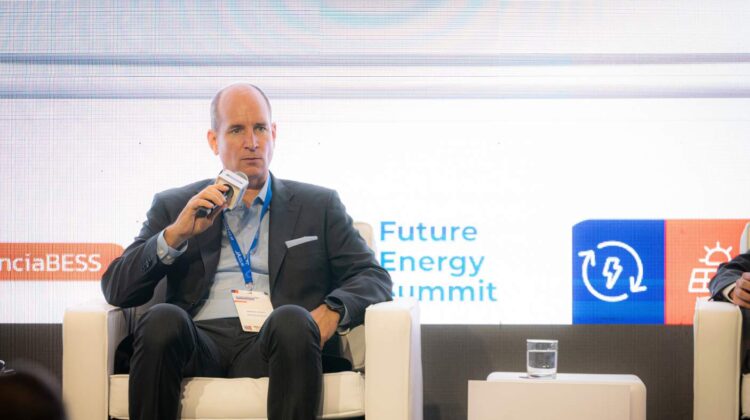
During the Future Energy Summit (FES) Southern Cone, Peruvian energy lawyer Brendan Oviedo, partner in the Energy & Climate Change practice at Hernández & Cía and former president of the Peruvian Renewable Energy Association, delivered a clear diagnosis of the structural barriers slowing Peru’s energy transition.
“In Peru, if you don’t have a PPA, you don’t finance a project,” Oviedo stated, describing why solar PV and wind power projects remain non-bankable despite growing investor interest.
Peru’s electricity market still lacks a mature demand base capable of signing long-term power purchase agreements (PPAs)—contracts essential for securing debt financing. “The question is: who buys that PPA? Who sells that PPA? That’s the challenge,” he said. Even though Peru has separated energy and capacity products, strong offtakers and long-term contracting practices have yet to emerge.
Another factor shaping the investment climate is the behavior of local banks, which share risk perceptions with lenders active in neighboring Chile. “We share the same bankers as Chile, and as a result they’re very sensitive to system issues and contracting problems,” Oviedo explained. The lack of firm contracts, uncertainty around curtailment, and limited experience with medium- and long-term agreements reinforce this caution.
From a cost perspective, Peru’s marginal cost currently stands at around USD 25/MWh, with monthly averages near USD 30/MWh. During droughts, however, prices can spike to USD 70–80/MWh when thermal generation is dispatched more heavily. According to Oviedo, these fluctuations create a growing opportunity for renewable energy and energy storage, especially given the structural constraints of the natural-gas sector. “We rely on a single pipeline, and there are no efficient proposals for new ones,” he warned.
Against this backdrop, Law 32249, approved in January, marks an important step toward modernizing Peru’s electricity market. The law introduces new market mechanisms designed to increase flexibility, predictability, and competitiveness. However, Oviedo stressed that the law still requires detailed regulation before its impacts are felt. “Only the first draft regulation for distribution-company auctions has been published,” he noted, adding that no draft has yet been issued for ancillary services, which are expected to become operational in 2026.
A milestone of the new framework is the creation of an ancillary services market, incorporating a new type of service provider that opens the door for stand-alone energy storage systems—key for improving system reliability and boosting project bankability. The legislation also aims to ensure that renewable generators are no longer exempt from providing primary and frequency regulation services, helping close operational gaps.
Technically, Peru has 15 GW of installed capacity and a peak demand of 8 GW, leaving significant headroom for renewable growth. Today, generation consists of roughly 50% hydropower, 38% thermal (mainly natural gas), and just 12% non-conventional renewables—falling to 10% depending on seasonal variation.
“But the potential is immense. We have more than 20,000 MW in wind and solar projects going through electrical studies,” Oviedo said, adding that “the coming years will be renewable years.” The challenge now is converting this pipeline into real investment, which will depend directly on designing effective contracting mechanisms.
Lessons from Chile: avoiding past mistakes and accelerating Peru’s transition
Despite the challenges, Oviedo expressed optimism about the insights Peru can draw from Chile’s experience. “Thanks to their experience, we’ll be able to implement reforms—hopefully with great efficiency,” he said. He acknowledged, however, that Peru is about ten regulatory years behind Chile, especially regarding renewables and energy storage.
One key difference is the robustness of Peru’s transmission network. Since 2006, the country has implemented a system of auctions for guaranteed transmission lines under a scheme known as complementary TRONCAL. These lines are awarded with 30-year contracts, remunerated through CAPEX and OPEX tariffs. “We have a fairly robust system,” Oviedo emphasized, noting that Peru’s wider geography—compared with Chile’s narrow territory—allows for a more meshed configuration that reduces bottlenecks.
Looking ahead, Oviedo underscored the urgency of a clear energy policy and a consistent development plan capable of aligning public and private decision-making. “Policies have been drafted for years, but it’s essential to have a clear view of the regulation that will be implemented,” he said.
He closed with a remark reflecting both optimism and the political volatility that affects Peru’s investment climate: “I just pray we have one president for the next five years… and that if they finish their term, they don’t end up in jail,” he joked, alluding to the institutional instability shaping energy-sector expectations.